
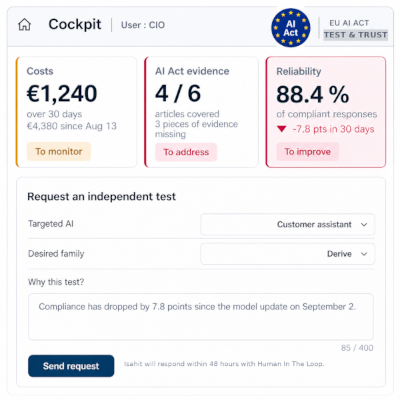
isahit brings qualified humans into the AI lifecycle to help companies test AI behaviour, validate oversight mechanisms and document results.
Qualified human evaluators review AI outputs and decisions according to predefined criteria such as: accuracy, relevance, hallucination, consistency, safety and bias.
Structured evaluation makes AI performance measurable beyond automated benchmarks.
The AI Act places particular emphasis on effective human oversightfor high-risk AI systems.
isahit can help test whether human supervision actually works in practice.
The objective is not only to test the AI. It is to test:AI + Human + Interface + Procedure
AI systems need to be tested beyond normal situations.
isahit can organise human evaluation campaigns around: edge cases, ambiguous instructions, adversarial scenarios, unexpected outputs, bias and safety risks.
Human testers actively look for situations where an AI system may fail, behave inconsistently or require human intervention.
High-quality training, validation and testing data remains fundamental to trustworthy AI.
isahit supports: dataset validation, human QA, multi-level review, consensus workflows and expert validation.
This extends our historical expertise in data annotation and quality assurance into AI validation workflows.
Testing becomes much more useful when it can be documented.
isahit workflows can capture:
which AI version was tested
which scenario was evaluated
which output was produced
who reviewed it
which criteria were applied
which correction was made
what the final result was
The goal is to transform human evaluation into measurable and auditable evidence.
AI validation should not necessarily stop when a system goes live.
Production interactions can be periodically sampled and sent for human review to detect: quality drift, recurring errors, unsafe behaviour, bias or unexpected AI decisions.
This enables an ongoing loop:
Monitor → Review → Measure → Improve
Describe your project and access our on-demand workforce. With an ethical touch.
Start a Small Data Labeling Project for Free, right now, thanks to our user-friendly annotation tool!
Learn more about our Community, our job opportunities and start making money while learning new skills.