By clicking “Accept”, you agree to the storing of cookies on your device to enhance site navigation, analyze site usage, and assist in our marketing efforts. View our Privacy Policy for more information.

Physical AI : bringing Human-in-the-Loop to the real world

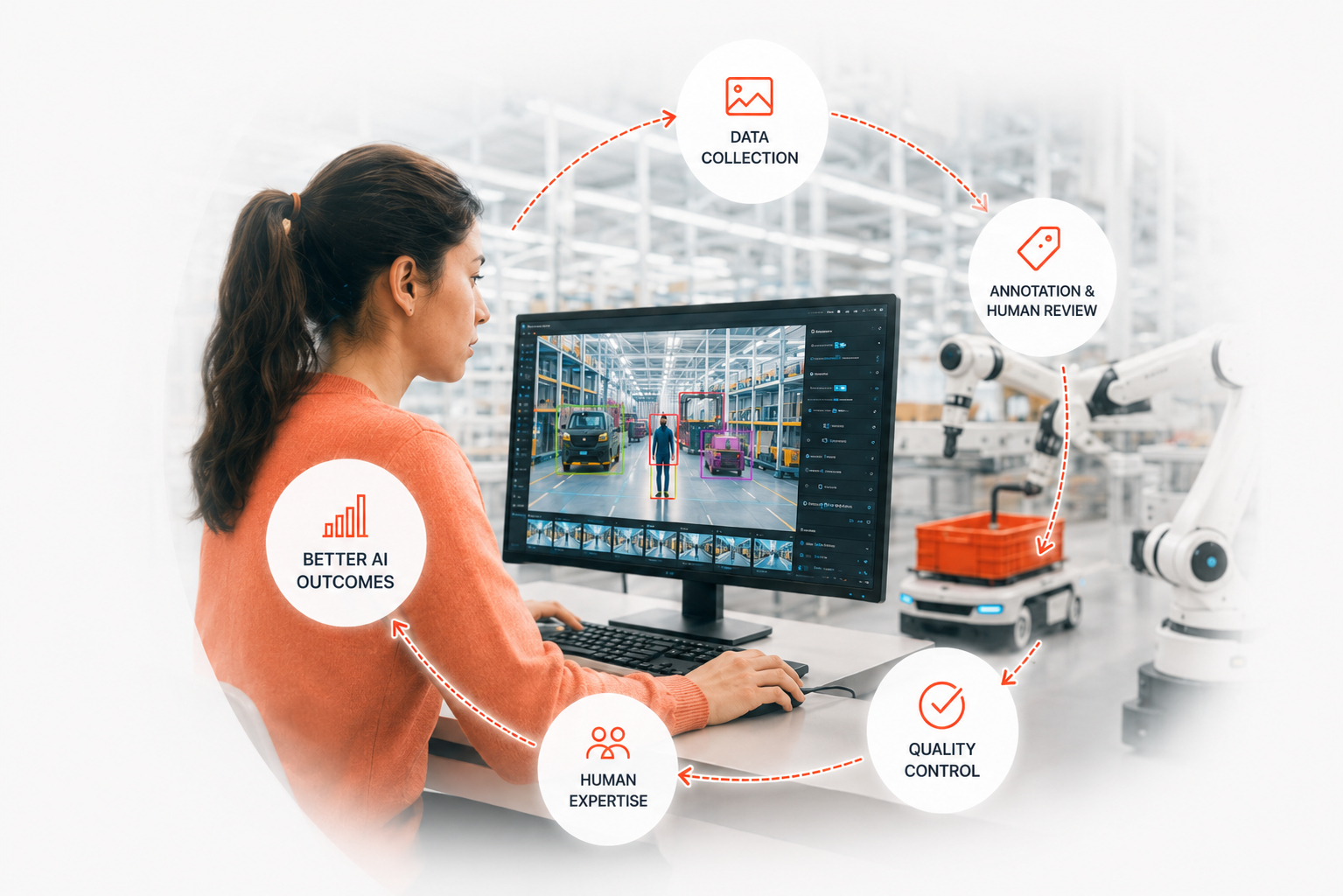
Physical AI combines artificial intelligence, robotics, sensors, video, simulation and real-world feedback. Isahit supports companies in creating, validating and improving the datasets needed to train and evaluate these systems.

From video annotation and scene understanding to human evaluation of robotic actions, autonomous systems and world models, Isahit provides scalable human-in-the-loop workflows to make Physical AI safer, more reliable and better adapted to real-life environments.

What is Physical AI?

Physical AI refers to artificial intelligence systems designed to operate in or understand the physical world. It includes robotics, autonomous systems, smart mobility, industrial automation, embodied AI, world models and AI systems trained on real-world or simulated physical scenarios.

Unlike purely digital AI, Physical AI needs to understand context, spatial relationships, movement, objects, environments, human actions and safety constraints. This makes human validation essential throughout the data and model lifecycle.

How Isahit can help?
How Isahit supports Physical AI projects

Isahit provides human-in-the-loop services to help teams build reliable Physical AI systems, from dataset creation to model evaluation and continuous improvement.

1.
Video and image annotation

Bounding boxes, segmentation, object tracking, action recognition, scene labelling and spatial understanding for complex visual environments.

2.
Scenario-based dataset creation

Creation and enrichment of datasets based on predefined physical scenarios, including specific actions, environments, edge cases and expected behaviours.

3.
Human evaluation of AI behaviour

Human review of model outputs, robot actions, autonomous decisions or simulated behaviours to assess accuracy, safety and relevance.

4.
Quality control and data validation

Multi-level review workflows, consensus mechanisms and expert validation to ensure high-quality datasets and reliable model feedback.

5.
World model and simulation support

Annotation and evaluation of physical scenes, video sequences and synthetic or real-world data used to train world models and embodied AI systems.

6.
Continuous improvement loops

Feedback collection, error analysis and iterative data enrichment to improve Physical AI systems after deployment or during testing phases.